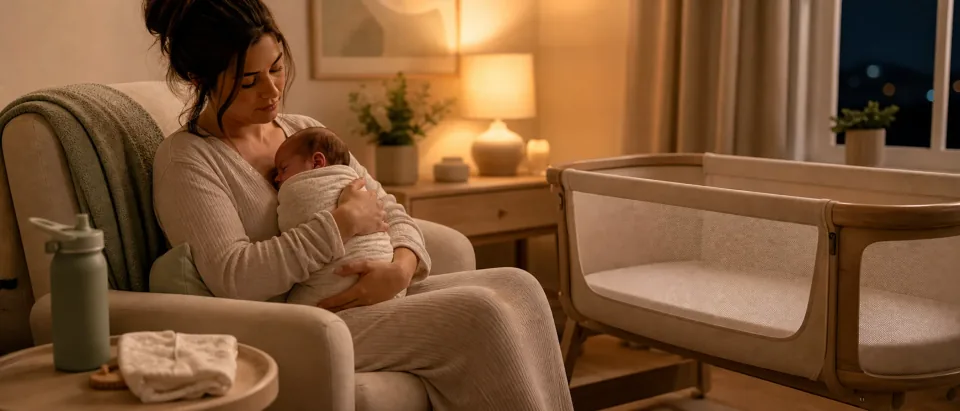
If your newborn will not sleep unless held, you are not failing; you are in a common newborn problem with a real safety boundary. Holding can soothe a baby, but an adult falling asleep while holding a baby raises risk. Aim for a flat, firm, empty sleep space for every sleep, and make a backup plan before you are too tired to choose safely.
Source basis: This guide cross-checks the practical answer against HealthyChildren, CDC, NHS and the full references listed below.
Newborns are wired for closeness
Newborns often prefer contact because warmth, motion, smell, feeding, and body pressure are soothing. Safe sleep guidance does not deny that biology; it gives a safer place for sleep when the adult may fall asleep too.
The most important practical distinction is awake holding versus accidental shared sleep on a couch, chair, recliner, or soft bedding. Couches and chairs are especially risky for sleep.
When held sleep becomes a safety problem
Contact naps while an adult is awake are different from an adult drifting off with baby on a couch, chair, recliner, or soft bed. The risk rises when the caregiver is exhausted enough to sleep accidentally.
The early weeks are often the hardest. That is why the plan should be made before midnight, not after you have already been awake for hours.
Awake soothing
Holding, rocking, and contact can be part of settling when an adult is alert.
Adult may fall asleep
Move baby to a firm, flat, empty sleep space or ask another awake adult to take over.
Build a tired-parent plan
Plan for the sleepy adult, not the ideal adult. Set up the bassinet before the feed, decide who can take over, and move baby before drowsiness turns a contact nap into unsafe sleep.
When to get care advice
Call the pediatrician urgently for blue or gray color, pauses in breathing, chest pulling in, nostril flaring, fever in a young baby, poor feeding, unusual limpness, or unusual sleepiness. Also ask for help if adult exhaustion makes safe sleep feel impossible tonight.
If baby only settles on a body and you are nearing exhaustion, ask for help before the next feed rather than waiting until you are already nodding off.
Call now
If unsure
How we checked this
This guide uses HealthyChildren/AAP, CDC, and NHS safe-sleep guidance. The article separates normal newborn contact-seeking from the safety risk that appears when a tired adult falls asleep while holding baby.
The guide keeps safe-sleep guidance firm while recognizing the real problem: an exhausted adult trying to survive the night with a baby who wakes on transfer.
How Doola researched this guide
Doola started with the search question “newborn won't sleep unless held,” then checked the concern against trusted public-health, pediatric, obstetric, dermatology, or postpartum sources rather than forum answers alone.
The visible guidance was written from the decision points those sources support: what is more reassuring, what changes risk, what to do next, and when to contact a clinician. Primary references include HealthyChildren.org, CDC, NHS.
This guide cannot diagnose reflux, feeding trouble, breathing issues, or sleep disorders. It helps parents name the sleep pattern and exhaustion risk so pediatric advice can be more specific.
References
Source-cited references used for this article. Open the original guidance when you want the public-health details behind the summary.