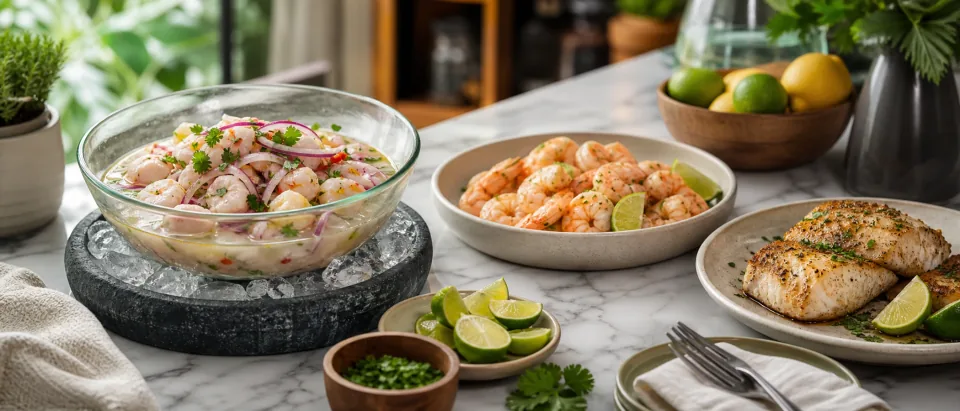
Ceviche during pregnancy: lime juice is not the same safety step as heat-cooking seafood. Ceviche is usually raw or undercooked fish or shellfish that has been acid-marinated, and FDA/CDC pregnancy food-safety guidance favors seafood cooked thoroughly. Safer move: choose cooked shrimp, cooked fish, a cooked roll, or a hot seafood dish instead.
Source basis: This guide cross-checks the practical answer against FDA, CDC, FDA/EPA and the full references listed below.
Lime changes the texture. Heat changes the safety question.
Ceviche during pregnancy is different from a cooked seafood dish because the fish or shellfish is usually marinated in citrus instead of cooked with heat. FDA seafood safety guidance names ceviche as a raw or undercooked seafood example that pregnant people and other higher-risk groups should avoid. CDC pregnancy food-safety guidance points toward seafood cooked until it is opaque or shellfish cooked until shells open.
The calmer way to handle the craving is not to avoid all seafood. Choose cooked shrimp, cooked fish, canned seafood, or another low-mercury cooked option. That keeps the seafood benefit while removing the raw-seafood uncertainty.
Cooked seafood
Acid-marinated raw seafood
Swap the preparation
After eating
Exact seafood
Cooked shrimp or cooked fish
Ceviche or aguachile
Already ate ceviche
Why ceviche gets a different answer from cooked fish
FDA seafood guidance explains that some people, including pregnant people, should avoid raw or undercooked fish or shellfish and foods containing raw or undercooked seafood, with ceviche listed as an example. The reason is practical: raw seafood can carry germs or parasites, and citrus curing is not the same safety step as cooking.
That does not erase the value of seafood during pregnancy. FDA/EPA fish advice supports lower-mercury seafood as part of pregnancy nutrition. The safer path is cooked, lower-mercury seafood rather than acid-marinated raw seafood.
The misconception
The better swap
The restaurant question
Restaurants, travel, and shrimp ceviche
Ceviche often shows up at restaurants, beach trips, and family gatherings, where it is harder to verify seafood source, refrigeration, water, ice, and timing. That uncertainty matters. A reputable restaurant can reduce some risk, but it does not turn raw seafood into cooked seafood.
Shrimp ceviche follows the same rule. If the shrimp was actually cooked before chilling and mixing, it is a different dish from raw shrimp cured in lime. If no one can confirm, choose cooked shrimp instead.
If you already ate ceviche
If you already ate ceviche while pregnant, write down the seafood type, restaurant or source, date and time, portion size, whether the seafood was raw or cooked before marinating, and whether anyone else who ate it became sick. One exposure does not mean you will become ill, but those details make the conversation clearer if symptoms appear or you call for advice.
Call your care team if you develop fever, repeated vomiting, diarrhea, dehydration, severe cramps, blood in stool, or you feel seriously unwell after raw seafood. Also call sooner if the seafood was recalled, smelled spoiled, came from uncertain refrigeration, or was eaten while traveling where water, ice, or handling was hard to verify.
Details to keep
Symptoms that matter
Next meal reset
You can still eat seafood
The takeaway is not no seafood during pregnancy. The clearer rule is to choose seafood that is cooked and lower in mercury, because FDA/EPA guidance supports safe seafood choices for pregnancy nutrition. Ceviche is different because the seafood is usually acid-marinated rather than heat-cooked, so it keeps the raw-seafood concern even when it looks opaque.
Good swaps keep the meal satisfying without the raw step: cooked shrimp, grilled salmon, trout, tilapia, sardines, seafood soup, or another hot cooked seafood dish. If a restaurant can confirm the shrimp or fish was fully cooked before chilling and mixing, that is a different question from seafood that was only cured in lime.
Sources behind this ceviche guide
We checked FDA seafood safety guidance, FDA/EPA fish advice, CDC pregnancy food-safety guidance, FoodSafety.gov pregnancy guidance, and ACOG raw-fish guidance. We used those sources to answer the parent question directly: whether lime-cured seafood counts as cooked, what safer seafood looks like, and when symptoms after raw seafood should move the question to a clinician.
References
Source-cited references used for this article. Open the original guidance when you want the public-health details behind the summary.
 ACOG: Can I Eat Sushi While Pregnant?
acog.org
open_in_new
ACOG: Can I Eat Sushi While Pregnant?
acog.org
open_in_new