Pregnancy due date calculator.
Doola's pregnancy due date calculator estimates your due date, current pregnancy week, trimester, and key milestones from your last menstrual period, also called LMP, or from an existing due date. It is built for planning and education, then points you toward Doola's pregnancy food, ingredient, and label-checking tools for everyday questions.
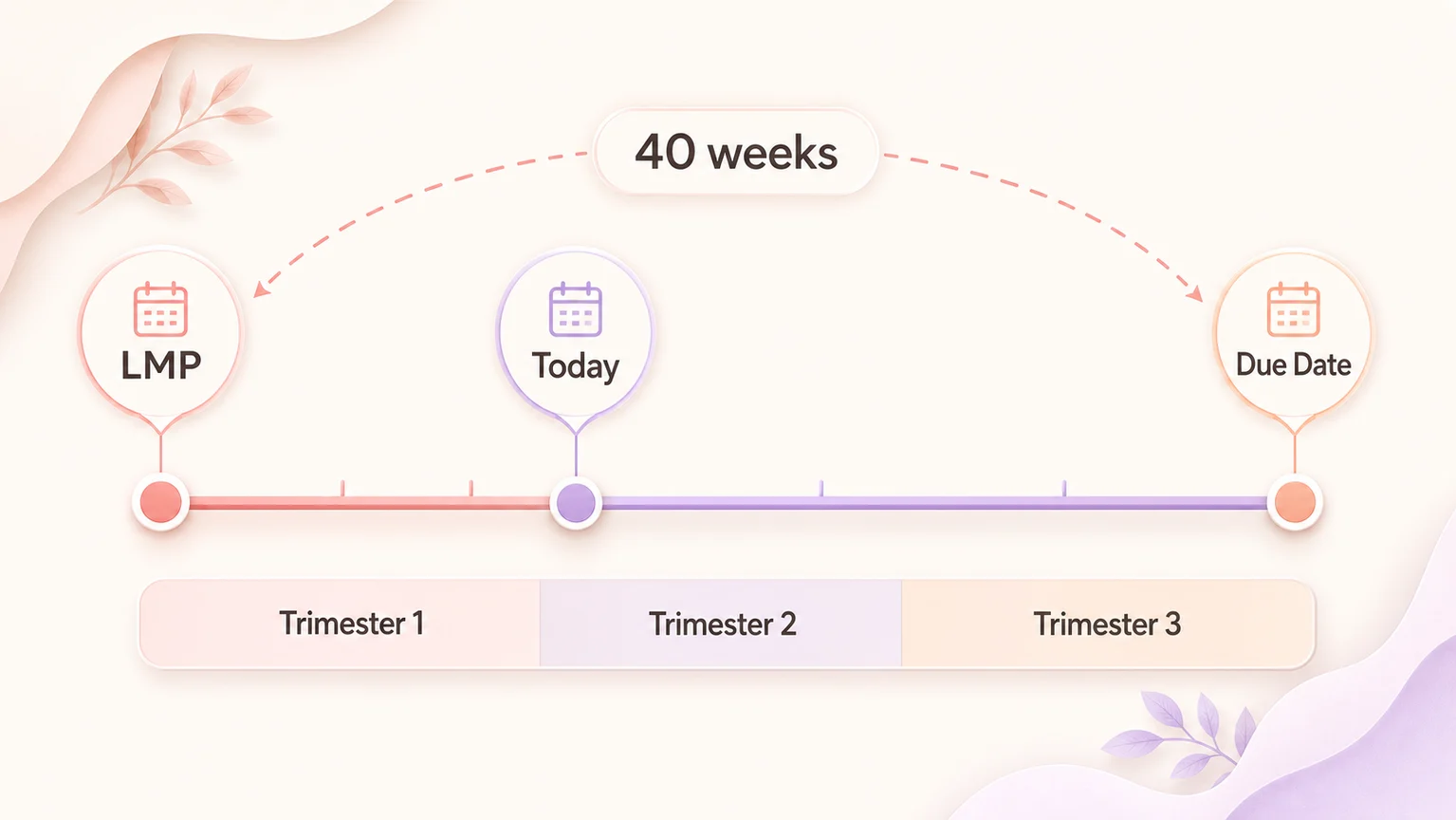
How this calculator works
How does the pregnancy due date calculator work?
A pregnancy due date calculator estimates your estimated due date, or EDD, by adding 280 days, or 40 weeks, to the first day of your last menstrual period. Doola also uses that estimated LMP date to calculate how many weeks pregnant you are today, which trimester you are in, and common milestone dates such as trimester starts.
LMP + 280 days = estimated due date.
Due date - 280 days = estimated LMP.
Today - estimated LMP = estimated gestational age in weeks and days.
LMP
Last menstrual period. For pregnancy dating, this usually means the first day your last period began.
EDD
Estimated due date. It is a planning estimate, not a guarantee that birth will happen on that date.
Gestational age
How far along pregnancy is usually described in weeks and days, often counted from LMP.
Key assumption
The 280-day estimate assumes common dating conventions and does not replace clinician dating.
Source-backed dating rule
ACOG, Mayo Clinic, and Cleveland Clinic all point to the same planning estimate.
For searchers comparing official pregnancy due-date calculators, Doola's date math follows the common LMP convention: estimate 40 weeks, or 280 days, from the first day of the last menstrual period, then treat the result as a planning estimate.
ACOG
EDD and LMP
Uses an estimated due date and describes pregnancy timing in weeks, with the familiar 40-week convention behind LMP-based planning.
Mayo Clinic
280 days from last menstrual period
Explains due date estimation by adding 280 days, or 40 weeks, to the first day of the last menstrual period.
Cleveland Clinic
Due date calculator limits
Frames a pregnancy due date calculator as an estimate and notes that cycle details and clinical dating can change the final date.
Doola uses this for education only; ultrasound dating, IVF, irregular cycles, cycle length, and your clinician's judgment can change the date used for care.
What you will see after calculating
A date estimator, not a medical decision.
This pregnancy calculator uses common pregnancy dating estimates described by ACOG, Mayo Clinic, and Cleveland Clinic, including the 280-day LMP method. The result is useful for planning, but it is not medical advice, diagnosis, treatment, or clinician dating. Your actual due date can change based on ultrasound dating, cycle length, fertility treatment, symptoms, IVF or embryo transfer details, or your clinician's care advice.
How many weeks pregnant am I?
Enter the first day of your last menstrual period to estimate how many weeks and days pregnant you are today. Doola counts from that estimated LMP date because pregnancy dating is commonly described in gestational age. If you already have a clinician-given due date, enter that due date instead and Doola will work backward to estimate the LMP date used for the calculation.
What trimester am I in?
Doola estimates first, second, or third trimester from gestational age, which is the weeks-and-days count usually measured from LMP. The calculator treats pregnancy before 14 weeks as first trimester, 14 weeks through 27 weeks as second trimester, and 28 weeks onward as third trimester, while keeping the result educational rather than clinical.
What should I check next?
After you estimate your due date and current week, the next useful step is usually everyday safety context. Doola Scan and Doola Learn help with pregnancy food questions, skincare ingredients, supplements, product labels, and practical safer-choice research that comes up across pregnancy. Use the calculator for dates, then use Doola's source-linked pages for label and ingredient questions.
Related Doola pages
Pregnancy and baby toolsPregnancy week-by-week guidePregnancy weight gain calculatorBaby names 2026 explorerBaby week-by-week guideBaby growth chart calculatorPregnancy food checkerPregnancy ingredient checkerPregnancy food safety hubDoola Scan appQuestions parents ask
How does this pregnancy calculator estimate my due date?
This pregnancy due date calculator estimates your due date by adding 280 days, or 40 weeks, to the first day of your last menstrual period. ACOG, Mayo Clinic, and Cleveland Clinic all describe LMP-based due date calculation as a common estimating method. If you enter an estimated due date instead, Doola works backward 280 days to estimate an LMP date, then uses today's date to estimate weeks pregnant, trimester, and milestone dates.
What does LMP mean in pregnancy dating?
LMP means last menstrual period. In pregnancy dating, LMP usually refers to the first day your last period began before pregnancy. ACOG and Mayo Clinic describe LMP as a common starting point for estimating due date because many people can identify that date more easily than conception or ovulation. Irregular cycles, fertility treatment, and ultrasound dating can still change the date used for care.
Why is pregnancy counted from the last period instead of conception?
Pregnancy is commonly counted from LMP because the exact conception date is often uncertain. The familiar 40-week pregnancy estimate includes roughly the two weeks before ovulation and fertilization in a typical cycle. That is why someone can be described as about four weeks pregnant around the time a period is missed.
What is EDD?
EDD means estimated due date, or estimated date of delivery. ACOG uses EDD language for the date used to plan pregnancy timing, but an EDD is still an estimate, not a promise that birth will happen on that exact calendar day. Your clinician may update the EDD after reviewing cycle history, ultrasound dating, IVF or fertility treatment details, and your personal care context.
Is this pregnancy calculator medical advice?
No. Doola's pregnancy due date calculator is an educational date estimator, not medical advice, diagnosis, treatment, or a substitute for clinician dating. The page can help you understand LMP, EDD, weeks pregnant, trimester, and milestone estimates, but your clinician's dating is the date that matters for care decisions.
Can I use my due date to calculate how many weeks pregnant I am?
Yes. A due date can be used to estimate how many weeks pregnant you are by working backward 280 days to estimate an LMP date, then counting from that estimated LMP date to today. This mirrors the same LMP-based convention described by ACOG and Mayo Clinic. The result is still an estimate, especially if your due date came from ultrasound, IVF, embryo transfer, or a cycle pattern that does not match the 280-day convention.
Can ultrasound change my due date?
Yes. Ultrasound dating, especially early pregnancy ultrasound, can lead a clinician to confirm or adjust a due date. Cleveland Clinic notes that due date calculators have limits, and ACOG guidance also treats dating as something clinicians may confirm or revise. Cycle length, ovulation timing, IVF or embryo transfer dates, and differences between LMP dating and ultrasound measurements can all matter. Doola shows an educational estimate and does not replace clinician dating.
Can this calculator tell me whether a food or ingredient is safe in pregnancy?
No. This page only estimates pregnancy dates and timing. For food, skincare, supplement, product label, or ingredient-list questions, use Doola Scan, the pregnancy food checker, or the pregnancy ingredient checker. Those pages are designed for everyday safety questions, while this calculator is limited to LMP, EDD, weeks pregnant, trimester, and milestones.
Learn the terms