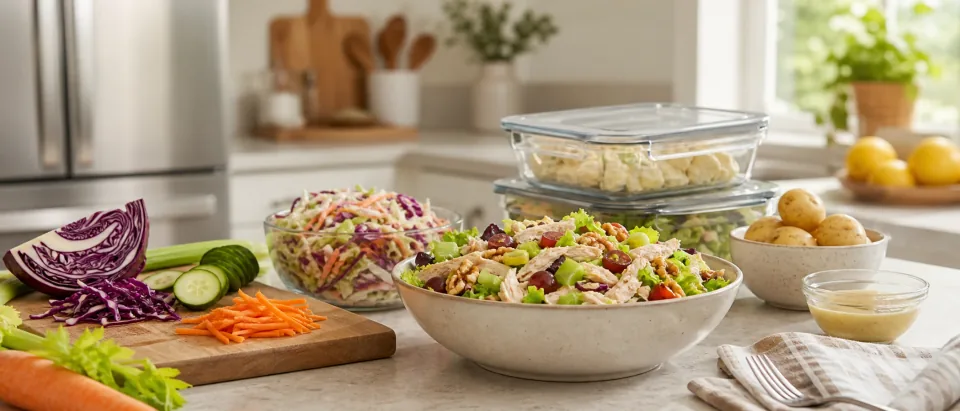
Prepared salads during pregnancy are safest when ingredients are fresh, fully cooked where needed, kept cold, and eaten promptly. Check first with chicken salad, coleslaw, potato salad, egg salad, and deli-case containers because age, refrigeration, raw egg, recalls, and handling change the answer. Choose a freshly made option when storage is unclear.
Source basis: This guide cross-checks the practical answer against CDC, FDA, FoodSafety.gov and the full references listed below.
Fresh at home is a different decision from the deli case
Prepared salads during pregnancy are easiest to judge by where they came from. CDC pregnancy food-safety guidance treats premade deli salads, including coleslaw, potato salad, tuna salad, chicken salad, and egg salad, as a riskier choice than homemade deli salads. That does not make every spoonful an emergency; it means the safer version is the one made fresh, kept cold, and eaten promptly.
The useful split is simple: homemade and freshly chilled is more reassuring; premade from a deli case, salad bar, or old container needs more caution. The concern is not mayonnaise by itself. It is ready-to-eat food that may have been handled, stored, or displayed long enough for germs such as Listeria to become a bigger pregnancy concern.
Homemade and cold
Premade deli salad
Choose the clearer version
After eating
Exact foods
Homemade chicken salad or potato salad
Deli coleslaw, tuna salad, chicken salad, or egg salad
Already eaten prepared salad
Why cold prepared salads get singled out
Cold prepared salads are ready-to-eat foods. They are usually eaten without another heating step, so safe handling has to happen before the food reaches your plate. CDC listeria guidance names deli salads such as coleslaw, potato salad, tuna salad, and chicken salad among ready-to-eat deli foods where contamination can matter more for pregnant people.
FDA guidance for moms-to-be also emphasizes keeping prepared foods refrigerated and avoiding risky ready-to-eat foods when the storage history is unclear. That is why a fresh bowl made at home with cooked chicken is not the same decision as a deli tub that has been opened, displayed, and chilled for an unknown amount of time.
The food is already ready to eat
The risky detail is often invisible
Homemade gives you control
How to choose chicken salad, coleslaw, or potato salad
Prepared-salad safety during pregnancy is a three-part check: cooked ingredients, cold storage, and clear handling. According to CDC pregnancy food-safety guidance, premade deli salads such as coleslaw, potato salad, tuna salad, chicken salad, and egg salad are riskier than homemade versions. In practice, homemade chicken salad, coleslaw, egg salad, tuna salad, or potato salad is more reassuring when proteins and eggs are fully cooked, utensils are clean, the salad is chilled promptly, and leftovers do not sit out.
Use the source as the deciding detail. First, choose homemade or made-to-order salad when possible. Second, treat a sealed retail tub as easier to judge only when it is in date, refrigerated, unopened, and not recalled. Third, be more cautious with deli-counter, buffet, salad-bar, or party-tray prepared salads because prep time, hand contact, display temperature, and open-container time are hard to verify. If those details are unclear, a hot freshly cooked meal is the safer swap.
If you already ate a deli salad
If you already ate prepared salad while pregnant and feel fine, pause before spiraling. Write down what it was, where it came from, when you ate it, and whether there is a recall. One serving does not mean you will get sick, but the details help if symptoms show up or if the product is later named in a recall.
Call your care team or local advice line if you develop fever, repeated vomiting, diarrhea, dehydration, severe cramps, blood in stool, or you feel seriously unwell. If the salad was recalled, call even sooner for individualized advice, especially because pregnancy changes how foodborne-illness risk is handled.
Keep the details
Do not self-diagnose from the food name
Use a calmer next meal
What not to overthink
You do not have to treat every salad as unsafe during pregnancy. CDC and FDA guidance focus the caution on ready-to-eat foods with unclear handling, storage, or refrigeration, not on fresh homemade salad where ingredients and timing are known. Mayonnaise alone is not the deciding factor; the bigger question is whether cooked ingredients stayed cold and whether the salad was handled safely after cooking.
The practical takeaway is narrower than no salad. Cold homemade salads, freshly assembled bowls, sealed in-date refrigerated products, and cooked ingredients chilled promptly are different from an open deli tub or buffet tray. Skip the version where the container sat open, the age is unknown, the package is expired, refrigeration is uncertain, or the product appears in a recall.
Sources behind this prepared-salad guide
We checked CDC pregnancy food-safety tables, CDC listeria guidance for deli ready-to-eat foods, FDA ready-to-eat food guidance for moms-to-be, and FoodSafety.gov pregnancy guidance. We used those sources to separate exact food lookup intent from the broader prepared-salad question: what is safer, what needs caution, and when symptoms or recalls should move the question to a clinician.
References
Source-cited references used for this article. Open the original guidance when you want the public-health details behind the summary.