Start solid food at around 6 months, not before 4, say CDC, the NHS and WHO. Breast milk or formula stays the main drink all year, and honey and cow’s milk as a drink wait until 12 months (CDC, NHS).
Month by month
What to offer your baby, month by month
Around 6 months
- What to offer
- Small tastes. The NHS suggests a small amount once a day to begin, starting with single vegetables and fruit (such as broccoli, parsnip, sweet potato, carrot, apple or pear) as purees, mash or soft-cooked sticks. Pregnancy, Birth and Baby and Health Canada put iron-rich foods first: iron-fortified infant cereal, meat, fish, tofu and legumes.
- Drinks and milk
- Breast milk or formula stays the main drink. The NHS suggests sips of water from an open or free-flow cup with meals. The US Dietary Guidelines say up to 4 to 8 ounces of water a day once solids start.
See every row as a table
| Baby’s age | What to offer | Drinks and milk |
|---|---|---|
| Before 6 months | No solid food for most babies. CDC says starting foods before 4 months is not recommended, and Pregnancy, Birth and Baby says solids should not be given before 4 months. The NHS, WHO and Health Canada all point to around 6 months. | Breast milk or formula only. A CDC parent checklist says babies are not ready for water or other drinks for about the first 6 months. The NHS says formula-fed babies may need small sips of cooled boiled water in hot weather. |
| Around 6 months | Small tastes. The NHS suggests a small amount once a day to begin, starting with single vegetables and fruit (such as broccoli, parsnip, sweet potato, carrot, apple or pear) as purees, mash or soft-cooked sticks. Pregnancy, Birth and Baby and Health Canada put iron-rich foods first: iron-fortified infant cereal, meat, fish, tofu and legumes. | Breast milk or formula stays the main drink. The NHS suggests sips of water from an open or free-flow cup with meals. The US Dietary Guidelines say up to 4 to 8 ounces of water a day once solids start. |
| 7 to 9 months | Mashed, lumpier food and finger foods (NHS), gradually building toward 3 meals a day: breakfast, lunch and tea. WHO describes 2 to 3 meals a day at 6 to 8 months. Health Canada says lumpy textures should be offered no later than 9 months. | Milk is still the main drink. The NHS gives about 600 ml a day as a rough guide for formula-fed babies. No juice or other sweet drinks (NHS, CDC). |
| 10 to 12 months | Mashed, chopped and finger foods, including bigger chunks of soft food, at 3 meals a day (NHS). WHO lists 3 to 4 meals a day from 9 months plus 1 to 2 snacks if needed; the NHS says babies under 12 months do not need snacks and suggests an extra milk feed instead. | About 3 milk feeds a day, and roughly 400 ml for formula-fed babies as a guide (NHS). Cow's milk can go into cooking but is not a drink yet (NHS, CDC). Health Canada differs: it says cow's milk can start at 9 to 12 months. |
| 12 months and up | Pregnancy, Birth and Baby says most babies can eat what the rest of the family eats by 12 months. Honey is off the list until after the first birthday (NHS, CDC). | The US Dietary Guidelines say plain whole milk or unsweetened fortified soy milk can start after 12 months; the NHS says whole or semi-skimmed pasteurised milk can be a main drink from 1 year. Pregnancy, Birth and Baby suggests no more than 500 mL of cow's milk a day; Health Canada says no more than 750 mL. |
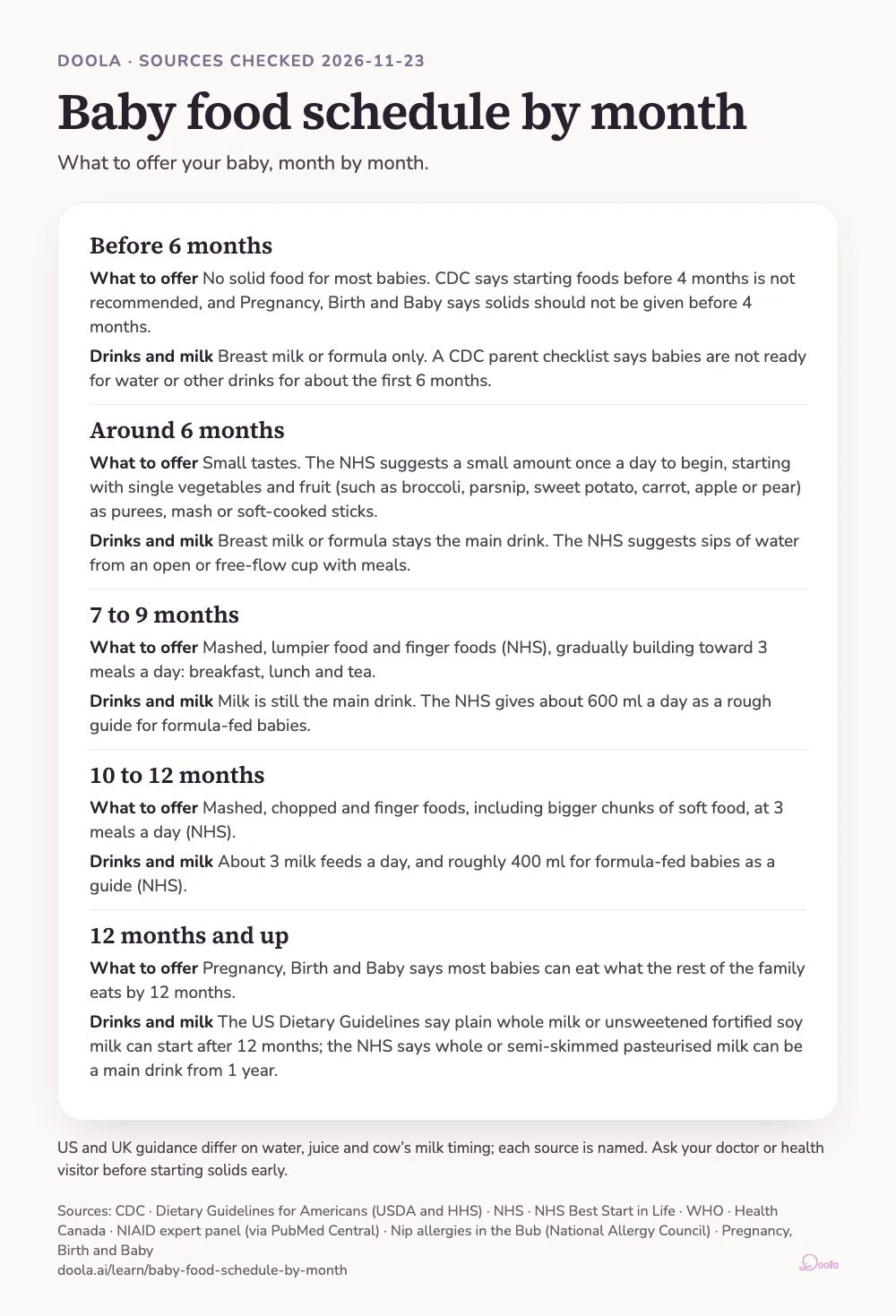
Baby food schedule by month, at a glance
Read each row as a rough guide, not a deadline. Babies move at their own pace, and the public-health sources below describe ranges rather than exact dates. Where US and UK advice differ, both versions are shown.
| Age | What to offer | Drinks and milk |
|---|---|---|
| Before 6 months | No solid food for most babies. CDC says starting foods before 4 months is not recommended, and Pregnancy, Birth and Baby says solids should not be given before 4 months. The NHS, WHO and Health Canada all point to around 6 months. | Breast milk or formula only. A CDC parent checklist says babies are not ready for water or other drinks for about the first 6 months. The NHS says formula-fed babies may need small sips of cooled boiled water in hot weather. |
| Around 6 months | Small tastes. The NHS suggests a small amount once a day to begin, starting with single vegetables and fruit (such as broccoli, parsnip, sweet potato, carrot, apple or pear) as purees, mash or soft-cooked sticks. Pregnancy, Birth and Baby and Health Canada put iron-rich foods first: iron-fortified infant cereal, meat, fish, tofu and legumes. | Breast milk or formula stays the main drink. The NHS suggests sips of water from an open or free-flow cup with meals. The US Dietary Guidelines say up to 4 to 8 ounces of water a day once solids start. |
| 7 to 9 months | Mashed, lumpier food and finger foods (NHS), gradually building toward 3 meals a day: breakfast, lunch and tea. WHO describes 2 to 3 meals a day at 6 to 8 months. Health Canada says lumpy textures should be offered no later than 9 months. | Milk is still the main drink. The NHS gives about 600 ml a day as a rough guide for formula-fed babies. No juice or other sweet drinks (NHS, CDC). |
| 10 to 12 months | Mashed, chopped and finger foods, including bigger chunks of soft food, at 3 meals a day (NHS). WHO lists 3 to 4 meals a day from 9 months plus 1 to 2 snacks if needed; the NHS says babies under 12 months do not need snacks and suggests an extra milk feed instead. | About 3 milk feeds a day, and roughly 400 ml for formula-fed babies as a guide (NHS). Cow's milk can go into cooking but is not a drink yet (NHS, CDC). Health Canada differs: it says cow's milk can start at 9 to 12 months. |
| 12 months and up | Pregnancy, Birth and Baby says most babies can eat what the rest of the family eats by 12 months. Honey is off the list until after the first birthday (NHS, CDC). | The US Dietary Guidelines say plain whole milk or unsweetened fortified soy milk can start after 12 months; the NHS says whole or semi-skimmed pasteurised milk can be a main drink from 1 year. Pregnancy, Birth and Baby suggests no more than 500 mL of cow's milk a day; Health Canada says no more than 750 mL. |
Is your baby ready? Signs, 4-month questions, and babies born early
Age is only half the answer; the other half is what your baby can do. The NHS looks for three signs together, usually from around 6 months: your baby can stay sitting up and hold their head steady, look at food, pick it up and bring it to their mouth, and swallow food rather than push it back out. The NHS also notes that chewing fists, waking more at night or wanting extra milk are not signs of readiness.
CDC lists similar signs, with a few extras: sitting up alone or with support, good head and neck control, opening the mouth when food comes near, and moving food to the back of the tongue to swallow. CDC is clear that starting before 4 months is not recommended.
If your baby was born early, the timing can be different. Pregnancy, Birth and Baby says premature babies can usually start solids at a corrected age of 3 months, and that starting by 7 months actual age matters, with the exact timing depending on how early they were born and how they are developing. The NHS simply advises asking your health visitor or GP. Either way, this is one to plan with your baby's care team.
Usually a go
Not a readiness sign
Check first
Allergy or eczema in the family: introducing peanut, egg and other allergens
Common allergy foods do not need to wait. The NHS says foods such as cows' milk, eggs, gluten, nuts, seeds, soya, shellfish and fish can be introduced from around 6 months, one at a time and in very small amounts. Nip allergies in the Bub advises giving common allergy foods before the first birthday, and the US Dietary Guidelines say there is no need to delay them.
Eczema changes the plan for peanut. The US peanut-allergy prevention guidelines from NIAID split babies into three groups, and the first group should talk to their doctor before starting peanut.
A family history on its own is handled differently by different sources. Nip allergies in the Bub says to introduce the food anyway, while keeping any allergic family member safe. The NHS suggests checking with your GP or health visitor before nuts if there is a family history of allergies.
Talk to the doctor first
NIAID guidelines advise a doctor's evaluation, which may include allergy testing, before peanut is introduced. Other solids should start before peanut. CDC also says to talk with your child's doctor or nurse in this situation.
SourcePeanut around 6 months at home
NIAID guidelines suggest peanut-containing foods around 6 months, at home, after other solids have started.
SourcePeanut alongside other first foods
NIAID guidelines say peanut can come in at an age-appropriate time with other solid foods, following family preference.
SourcePurees, finger foods, or both
You do not have to pick a side. The NHS says some parents prefer baby-led weaning (finger foods only), others spoon-feed, and many do a mix of both. CDC describes starting with very smooth mashed, pureed or strained foods and moving to thicker, lumpier food as eating skills grow.
What matters most is that textures keep moving forward. The NHS suggests moving from purees to mashed and finger foods as soon as your baby is ready, and offering lumpy textures from around 6 to 7 months. Health Canada says lumpy textures should be offered no later than 9 months, and encourages finger foods for self-feeding.
Good first finger foods, per the NHS, are about the size of your finger, soft enough to break up easily, and long enough to grip: soft-cooked vegetable sticks, soft fruit slices such as banana, peach or melon, cooked pasta or potato, boneless fish or meat, boiled egg, and sticks of pasteurised full-fat hard cheese.
Shop-bought jars and pouches are fine now and then. The NHS suggests using them occasionally rather than every day, squeezing pouches onto a spoon instead of letting your baby suck from them, and choosing the lowest-sugar option on the label. For infant cereal, CDC suggests iron-fortified oat, barley or multigrain cereals rather than only rice cereal, because rice cereal can add to arsenic exposure.
First-week food ideas from the official first-food lists
These are ideas, not a set menu, and every food here appears on an official first-food list. Pace matters more than variety: CDC suggests one single-ingredient food at a time with 3 to 5 days between new foods, while the NHS asks for allergy foods to come in one at a time. If you follow the CDC spacing, this list covers your first few weeks, not just seven days.
Foods and drinks to skip in the first year
Most of these rules agree across countries. Where they do not, the difference is noted.
Gagging vs choking: how to tell the difference
Gagging is common when babies start solids, and it is part of learning to move food around the mouth. The NHS puts the difference simply: gagging is loud, and your baby may go red. Choking is quiet. On white skin, a choking baby may start to look blue; on brown or black skin, look at the gums, the inside of the lips, or the fingernails.
To lower the risk, CDC suggests keeping your baby sitting upright in a high chair, never eating in a car seat or stroller, and watching them the whole time they eat. The NHS says the same: always stay with your baby while they are eating.
If your baby is choking, the NHS first-aid steps for babies under 1 are back blows, then chest thrusts, and calling 999 (or your local emergency number) if the object does not come out. Even if it clears, get medical help afterwards. A baby first-aid course is worth doing before you start.
When to get help
Choking that does not clear
Signs of a severe allergic reaction
A milder reaction
Check in before you start
How we checked this
The Doola Research Team read the current weaning and infant-feeding pages from CDC, the US Dietary Guidelines, the NHS, WHO, Health Canada, Pregnancy, Birth and Baby, the NIAID peanut-allergy prevention guidelines and Nip allergies in the Bub, and kept only what those pages say. Where they disagree, such as cooled boiled water, juice, cow's milk timing, and whether milk or food comes first, each source's version is shown rather than blended. Sources were last checked on 23 November 2026.
This page is general education. It cannot tell you whether your baby is ready, assess an allergy, or replace advice from your baby's doctor, nurse or health visitor.
Questions parents ask about the baby food schedule
Can I start my 4 month old on baby food? expand_more
What stage 1 baby food should I start with? expand_more
What food can I give a 4 month old? expand_more
Can I give my 5 month old water? expand_more
Can I give my baby yogurt at 6 months? expand_more
What is the 3-6-9 rule for babies? expand_more
How many times a day should my baby eat solids? expand_more
Should I give milk or food first? expand_more
When can my baby have cow's milk? expand_more
References
Source-cited references used for this article. Open the original guidance when you want the public-health details behind the summary.
 Your baby's first solid foods
nhs.uk
open_in_new
What to feed your baby from around 6 months
nhs.uk
open_in_new
What to feed your baby at 7 to 9 months
nhs.uk
open_in_new
What to feed your baby at 10 to 12 months
nhs.uk
open_in_new
Choking and gagging on food
nhs.uk
open_in_new
How to stop a child from choking
nhs.uk
open_in_new
Foods to avoid giving babies and young children
nhs.uk
open_in_new
Drinks and cups for babies and young children
nhs.uk
open_in_new
The Doola app
The next question, answered with sources.
Scan menus, labels and plates, ask follow-up questions in your own words, and keep what you learn for your next appointment.