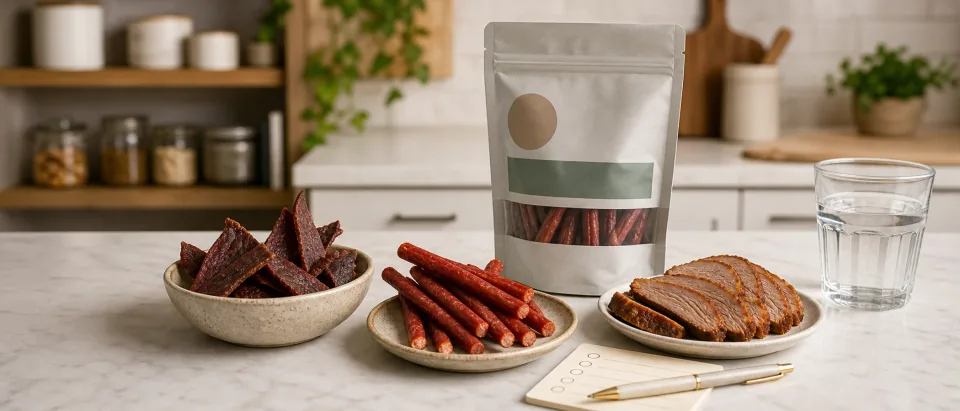
Beef jerky while pregnant is a label-and-storage question. Commercial packaged jerky from a reliable source is clearer when it is sealed, in date, stored as directed, and not recalled. Check first with homemade jerky, damaged packaging, unrefrigerated products that say refrigerate, and high sodium. Freshly cooked beef is the simpler choice if you feel unsure.
Source basis: This guide cross-checks the practical answer against USDA FSIS, CDC, FoodSafety.gov and the full references listed below.
Packaged jerky and homemade jerky are different
Beef jerky while pregnant is mostly a package-and-processing question. Commercially packaged jerky from a reliable source is different from homemade jerky where drying temperature, storage, and handling are unclear.
USDA FSIS explains that jerky safety depends on proper drying and pathogen control. During pregnancy, the practical check is package integrity, date, storage directions, recall status, and whether you would rather choose freshly cooked beef.
Clearer choice
Check or avoid
Practical step
After eating
Exact foods
Clearer choice
Check or avoid
Already ate it
Why the answer changes by version
Jerky is shelf-stable because of processing, but that does not make every jerky product identical. A sealed commercial product eaten before its date and stored as directed is easier to verify than homemade jerky, damaged packaging, or a recalled meat snack.
Sodium can also matter for some pregnancies. That is a nutrition and blood-pressure conversation, separate from the foodborne-illness check, but it is one reason freshly cooked beef can be the simpler choice.
Lower concern
Caution point
Best next move
How to order or prepare it
For packaged jerky, check the brand, intact seal, date, storage instructions, and recall status. For homemade jerky, the key question is whether it was made with validated time and temperature controls.
If you want the clearest pregnancy option, choose freshly cooked beef or another hot, cooked protein. If you choose jerky, pick a commercial sealed product, follow the label, and avoid damaged or recalled products.
If you already ate it
If you already ate beef jerky, one snack does not automatically mean something bad happened. Keep the package or write down the brand, date, storage instructions, and what made you unsure.
Call your care team if you develop fever, repeated vomiting, severe diarrhea, dehydration, severe cramps, or feel seriously unwell. Also call if the product was recalled, damaged, or clearly stored outside label directions.
Write down
Watch for
Ask for care advice
Safer swaps that keep the meal easy
The safer swap is not necessarily another packaged snack. It may be freshly cooked beef, a hot sandwich with cooked meat, or a sealed commercial jerky product you can verify.
If the only option is homemade jerky with unclear drying, damaged packaging, recalled meat snacks, or meat kept outside label directions, choose a different protein and move on.
At home
At restaurants
When unsure
How we researched this
We checked USDA FSIS jerky safety guidance, CDC pregnancy food-safety guidance, FoodSafety.gov, and FDA pregnancy food-safety resources, then mapped them to beef jerky decisions: commercial versus homemade, package integrity, storage, recalls, sodium, and symptoms. This guide is educational and does not diagnose or replace your care team.
References
Source-cited references used for this article. Open the original guidance when you want the public-health details behind the summary.