Most recovery takes about 6 weeks: ACOG says bleeding usually lasts 4 to 6 weeks, and the NHS says driving, lifting and exercise may not feel right until then. The scar takes longer, often 3 to 6 months (Pregnancy, Birth and Baby).
Week by week
Recovery after a C-section, from hospital to the first year
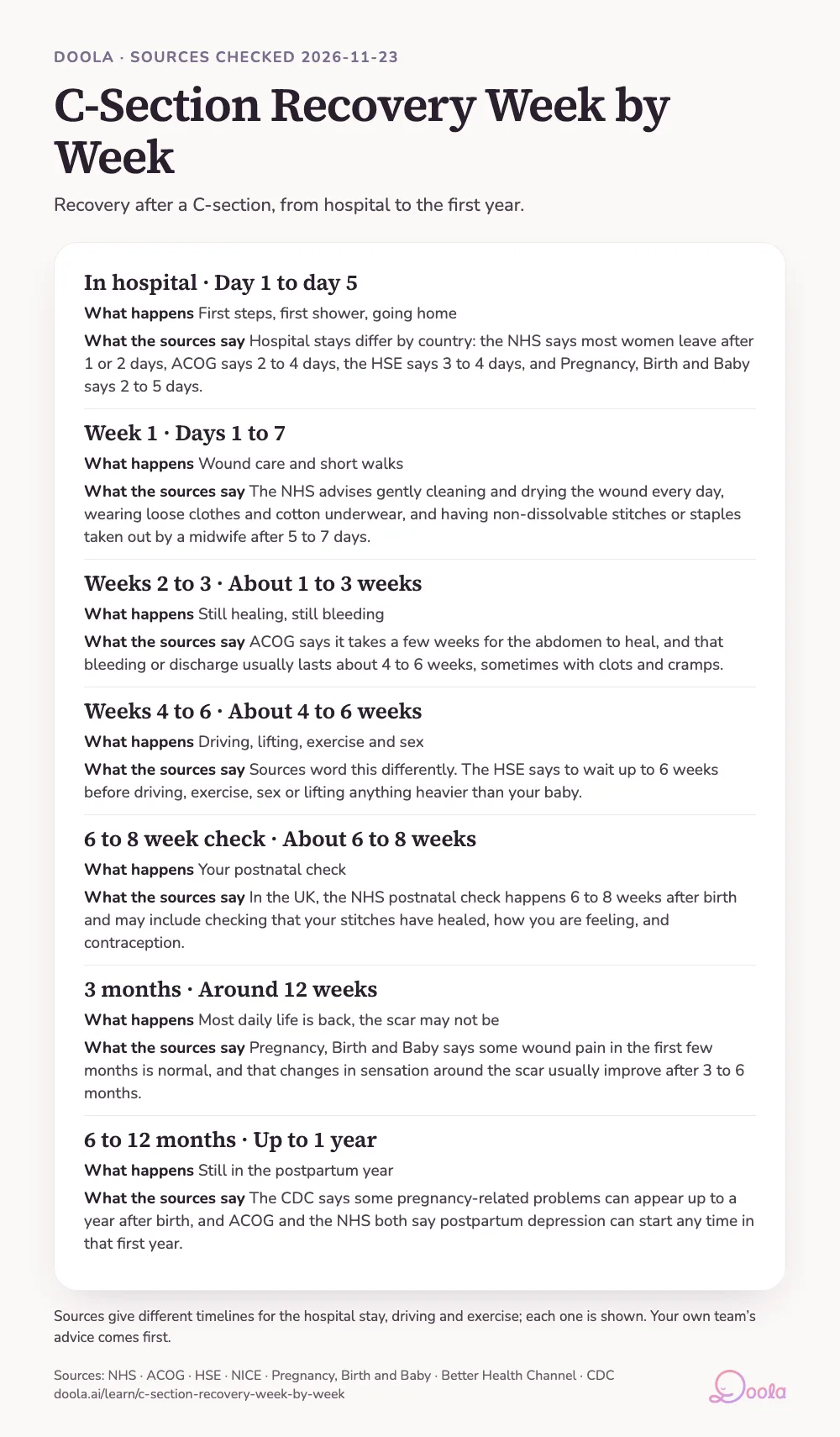
In hospital · Day 1 to day 5
- What happens
- First steps, first shower, going home
- What the sources say
- Hospital stays differ by country: the NHS says most women leave after 1 or 2 days, ACOG says 2 to 4 days, the HSE says 3 to 4 days, and Pregnancy, Birth and Baby says 2 to 5 days. NICE says women who are recovering well can be offered discharge after 24 hours with follow-up at home. The catheter usually comes out within about 12 hours, a midwife helps you out of bed the first time, and the HSE suggests deep breathing and leg exercises plus holding a pillow over the wound when you cough, laugh or get up.
See every row as a table
| Time since birth | What happens | What the sources say |
|---|---|---|
| In hospital · Day 1 to day 5 | First steps, first shower, going home | Hospital stays differ by country: the NHS says most women leave after 1 or 2 days, ACOG says 2 to 4 days, the HSE says 3 to 4 days, and Pregnancy, Birth and Baby says 2 to 5 days. NICE says women who are recovering well can be offered discharge after 24 hours with follow-up at home. The catheter usually comes out within about 12 hours, a midwife helps you out of bed the first time, and the HSE suggests deep breathing and leg exercises plus holding a pillow over the wound when you cough, laugh or get up. |
| Week 1 · Days 1 to 7 | Wound care and short walks | The NHS advises gently cleaning and drying the wound every day, wearing loose clothes and cotton underwear, and having non-dissolvable stitches or staples taken out by a midwife after 5 to 7 days. Some discomfort for the first few days is expected. Walk a little every day to lower the risk of blood clots, and use pads, not tampons, for bleeding. Follow the pain plan your care team gave you rather than waiting until the pain is bad. |
| Weeks 2 to 3 · About 1 to 3 weeks | Still healing, still bleeding | ACOG says it takes a few weeks for the abdomen to heal, and that bleeding or discharge usually lasts about 4 to 6 weeks, sometimes with clots and cramps. The HSE notes bleeding can increase with activity. ACOG recommends contact with your obstetric care provider within the first 3 weeks after birth. This is also when low mood can show up: ACOG says postpartum depression most often starts about 1 to 3 weeks after birth. |
| Weeks 4 to 6 · About 4 to 6 weeks | Driving, lifting, exercise and sex | Sources word this differently. The HSE says to wait up to 6 weeks before driving, exercise, sex or lifting anything heavier than your baby. The NHS says to restart these when you feel able and they are not uncomfortable, which may not be for 6 weeks or so. Better Health Channel says avoid driving until the wound has healed, usually about 6 weeks; Pregnancy, Birth and Baby says driving may take 2 to 6 weeks; and NICE says these activities can resume when you feel fully recovered. |
| 6 to 8 week check · About 6 to 8 weeks | Your postnatal check | In the UK, the NHS postnatal check happens 6 to 8 weeks after birth and may include checking that your stitches have healed, how you are feeling, and contraception. ACOG recommends a full postpartum visit no later than 12 weeks after birth. It is a good moment to ask about higher-impact exercise, which the NHS says to discuss at this check before starting. |
| 3 months · Around 12 weeks | Most daily life is back, the scar may not be | Pregnancy, Birth and Baby says some wound pain in the first few months is normal, and that changes in sensation around the scar usually improve after 3 to 6 months. Better Health Channel notes numbness or itching around the scar can last a long time. Recovery overall can take a few weeks or longer, especially after complications. |
| 6 to 12 months · Up to 1 year | Still in the postpartum year | The CDC says some pregnancy-related problems can appear up to a year after birth, and ACOG and the NHS both say postpartum depression can start any time in that first year. If you are thinking about another pregnancy, the HSE says wait at least 6 months, the NHS says at least 12 months is usually recommended, and ACOG says 18 months. |
Where are you in C-section recovery?
Pick the moment that matches you. Recovery after a caesarean is surgery recovery and birth recovery at the same time, so the wound, the bleeding, your energy and your mood can each move at a different speed.
Set up help before the birth
Soreness and short walks
Slowly doing more
The check, then the long tail
Fever, heavy bleeding, a hot red wound
C-section recovery week by week
These are typical ranges from public-health sources, not deadlines. A planned caesarean, an emergency caesarean after a long labour, or a complication such as an infection can each change the pace, and that is not a sign you are doing it wrong.
First steps, first shower, going home
Hospital stays differ by country: the NHS says most women leave after 1 or 2 days, ACOG says 2 to 4 days, the HSE says 3 to 4 days, and Pregnancy, Birth and Baby says 2 to 5 days. NICE says women who are recovering well can be offered discharge after 24 hours with follow-up at home. The catheter usually comes out within about 12 hours, a midwife helps you out of bed the first time, and the HSE suggests deep breathing and leg exercises plus holding a pillow over the wound when you cough, laugh or get up.
SourceWound care and short walks
The NHS advises gently cleaning and drying the wound every day, wearing loose clothes and cotton underwear, and having non-dissolvable stitches or staples taken out by a midwife after 5 to 7 days. Some discomfort for the first few days is expected. Walk a little every day to lower the risk of blood clots, and use pads, not tampons, for bleeding. Follow the pain plan your care team gave you rather than waiting until the pain is bad.
SourceStill healing, still bleeding
ACOG says it takes a few weeks for the abdomen to heal, and that bleeding or discharge usually lasts about 4 to 6 weeks, sometimes with clots and cramps. The HSE notes bleeding can increase with activity. ACOG recommends contact with your obstetric care provider within the first 3 weeks after birth. This is also when low mood can show up: ACOG says postpartum depression most often starts about 1 to 3 weeks after birth.
SourceDriving, lifting, exercise and sex
Sources word this differently. The HSE says to wait up to 6 weeks before driving, exercise, sex or lifting anything heavier than your baby. The NHS says to restart these when you feel able and they are not uncomfortable, which may not be for 6 weeks or so. Better Health Channel says avoid driving until the wound has healed, usually about 6 weeks; Pregnancy, Birth and Baby says driving may take 2 to 6 weeks; and NICE says these activities can resume when you feel fully recovered.
SourceYour postnatal check
In the UK, the NHS postnatal check happens 6 to 8 weeks after birth and may include checking that your stitches have healed, how you are feeling, and contraception. ACOG recommends a full postpartum visit no later than 12 weeks after birth. It is a good moment to ask about higher-impact exercise, which the NHS says to discuss at this check before starting.
SourceMost daily life is back, the scar may not be
Pregnancy, Birth and Baby says some wound pain in the first few months is normal, and that changes in sensation around the scar usually improve after 3 to 6 months. Better Health Channel notes numbness or itching around the scar can last a long time. Recovery overall can take a few weeks or longer, especially after complications.
SourceStill in the postpartum year
The CDC says some pregnancy-related problems can appear up to a year after birth, and ACOG and the NHS both say postpartum depression can start any time in that first year. If you are thinking about another pregnancy, the HSE says wait at least 6 months, the NHS says at least 12 months is usually recommended, and ACOG says 18 months.
SourceGetting home ready before a planned caesarean
If your caesarean is planned, a little setup makes the first weeks easier. Pregnancy, Birth and Baby suggests asking family and friends to help with housework, meals and caring for other children, and the HSE says to rest when you can and accept help. Plan on lifting nothing heavier than your baby at first, so anything heavier, like a full laundry basket or a toddler, needs another pair of hands.
Practical things the NHS and HSE mention: loose, comfortable clothes and cotton underwear that sit away from the wound, maternity or period pads rather than tampons, and a pillow to hold over your tummy when you cough or laugh. If you may need blood-thinning injections at home, the HSE says your midwife or doctor will show you how before you leave.
Looking after the scar, and spotting infection
The NHS says the scar is usually a horizontal line about 10 to 20 cm long just below the bikini line, and it should fade over time. Keep it clean and dry, pat it dry after washing, and let clothes sit loosely over it. NICE notes that wound, womb and urinary infections affect about 8% of women after a caesarean, so it helps to know what change looks like.
Contact your midwife, GP or care team promptly if the wound becomes more red, swollen or painful, oozes pus or smells bad, starts pulling apart, or you have a temperature of 38°C or more (HSE, Pregnancy, Birth and Baby). Numbness, itching and a tugging feeling near the scar on their own are common and usually ease over months.
Usually part of healing
Worth a call today
Your mood after a caesarean
ACOG says the baby blues often start 2 to 3 days after birth and usually lift within 1 to 2 weeks. Postpartum depression is different: it lasts longer, and ACOG says it most often starts 1 to 3 weeks after birth but can begin any time in the first year. The NHS lists signs such as persistent low mood, feeling unable to cope, trouble bonding with your baby, and thoughts of harming yourself or your baby.
If your caesarean was unplanned, it is normal to have mixed feelings about how the birth went. Better Health Channel suggests talking it through and asking your midwife about counselling if you feel very low, and NICE says women should be offered a chance to talk about why an emergency caesarean happened. NICE also notes a caesarean does not by itself raise the risk of depression. If you feel anger that frightens you, our guide to postpartum rage may help.
When to get help urgently
After a caesarean you have a higher risk of blood clots for about 6 weeks (HSE), and the CDC says some serious problems can appear up to a year after birth. Call emergency services or get urgent care for chest pain, trouble breathing, fainting, or thoughts of harming yourself or your baby. Contact your maternity team the same day for:
How we checked this
The Doola Research Team read the caesarean recovery pages from the NHS, ACOG, the HSE, NICE, Pregnancy, Birth and Baby, Better Health Channel and the CDC, and rechecked every link on November 23, 2026. Where they give different timings, such as for hospital stays, driving or the gap before another pregnancy, we show each one rather than picking a middle number. This guide is educational: it cannot assess your wound, decide your pain medicine, or replace advice from the team who did your surgery.
Questions people ask about C-section recovery
How long does it take to recover from a C-section? expand_more
When can I drive after a C-section? expand_more
When can I lift things after a C-section? expand_more
When can I exercise after a C-section? expand_more
When will my C-section scar stop hurting? expand_more
How long should I wait before getting pregnant again after a C-section? expand_more
Can I have a vaginal birth after a C-section? expand_more
What week is the hardest postpartum? expand_more
References
Source-cited references used for this article. Open the original guidance when you want the public-health details behind the summary.
 Caesarean section: Recovery
nhs.uk
open_in_new
 Cesarean Birth
acog.org
open_in_new
Postpartum Depression
acog.org
open_in_new
Optimizing Postpartum Care
acog.org
open_in_new
Birth Control After Pregnancy
acog.org
open_in_new
Exercise After Pregnancy
acog.org
open_in_new
Vaginal Birth After Cesarean Delivery
acog.org
open_in_new
Your 6-week postnatal check
nhs.uk
open_in_new
Keeping fit and healthy with a baby
nhs.uk
open_in_new
Sex and contraception after birth
nhs.uk
open_in_new
Postnatal depression
nhs.uk
open_in_new
The Doola app
The next question, answered with sources.
Scan menus, labels and plates, ask follow-up questions in your own words, and keep what you learn for your next appointment.