Pump as often as your baby would feed: about 8 to 12 times in 24 hours in the first weeks, including at night (CDC, HSE). Once supply is established, the HSE says you may be able to drop a session.
By age
How often to pump, by your baby’s age
First days
- Pumping sessions in 24 hours
- HSE: at least 10 to 12 times in 24 hours in the first few days. CDC: newborns often feed 8 to 12 times in 24 hours, as often as every 1 to 3 hours.
- Nights and what changes
- CDC says feeds happen through the night. For premature or ill babies, HSE asks for at least one session between midnight and 6am.
See every row as a table
| Baby’s age | Pumping sessions in 24 hours | Nights and what changes |
|---|---|---|
| First days | HSE: at least 10 to 12 times in 24 hours in the first few days. CDC: newborns often feed 8 to 12 times in 24 hours, as often as every 1 to 3 hours. | CDC says feeds happen through the night. For premature or ill babies, HSE asks for at least one session between midnight and 6am. |
| First weeks (building supply) | HSE: 8 to 10 times in 24 hours, aiming for about 700 to 900 ml a day by 4 to 6 weeks. HSE’s guide for premature or ill babies sets a floor of at least 8. | HSE (premature or ill babies): no gaps longer than 4 hours by day or 6 hours at night while supply is building. |
| 1 to 3 months | CDC: most exclusively breastfed babies feed every 2 to 4 hours, about 8 to 12 times in 24 hours. HSE: feeds may drop toward 8 a day as baby grows. | HSE: once supply is established it may be possible to drop a session without losing supply. Make changes one at a time, with support. |
| 3 to 6 months | No source we checked sets a separate count. HSE says babies 1 to 6 months on breast milk alone take about 750 ml a day; keep matching your baby’s feeds. | CDC notes some babies sleep 4 to 5 hours between feeds. HSE’s work guidance: do not go more than 8 hours without expressing or feeding. |
| 6 months and up, with solids | No set count. CDC says to keep following your baby’s hunger cues and that breast milk is still the most important food. | If baby seems less keen after starting solids, CDC suggests offering breast milk before other foods. |
A pumping schedule by baby’s age
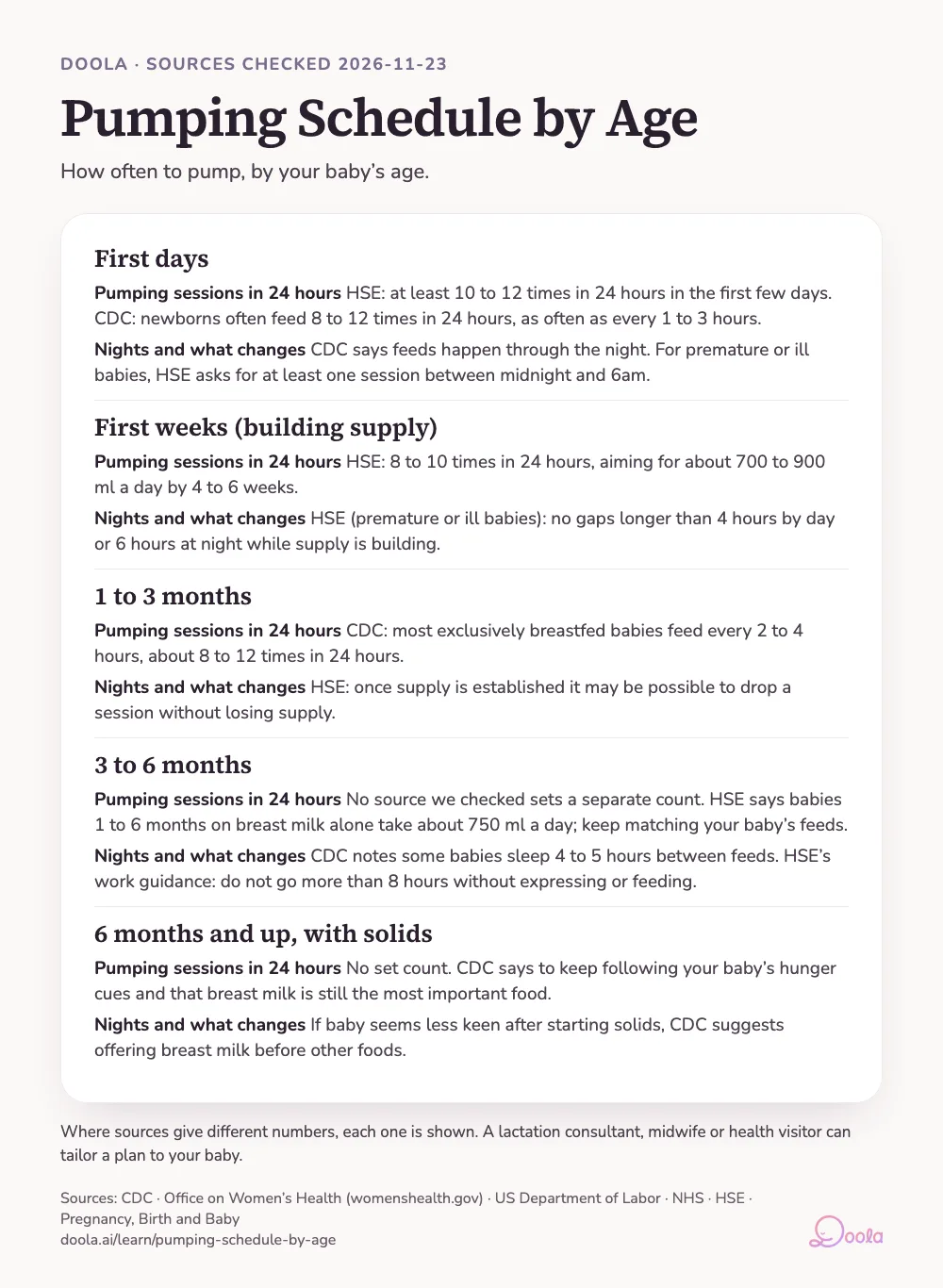
The simplest rule every source agrees on: pump when your baby would feed. CDC says that if your baby is not feeding at the breast, you should pump as often as your baby normally eats. The table puts each source’s numbers next to the age they apply to. Where a source gives no number for an age, we say so rather than fill the gap.
| Baby’s age | Pumping sessions in 24 hours | Nights and what changes |
|---|---|---|
| First days | HSE: at least 10 to 12 times in 24 hours in the first few days. CDC: newborns often feed 8 to 12 times in 24 hours, as often as every 1 to 3 hours. | CDC says feeds happen through the night. For premature or ill babies, HSE asks for at least one session between midnight and 6am. |
| First weeks (building supply) | HSE: 8 to 10 times in 24 hours, aiming for about 700 to 900 ml a day by 4 to 6 weeks. HSE’s guide for premature or ill babies sets a floor of at least 8. | HSE (premature or ill babies): no gaps longer than 4 hours by day or 6 hours at night while supply is building. |
| 1 to 3 months | CDC: most exclusively breastfed babies feed every 2 to 4 hours, about 8 to 12 times in 24 hours. HSE: feeds may drop toward 8 a day as baby grows. | HSE: once supply is established it may be possible to drop a session without losing supply. Make changes one at a time, with support. |
| 3 to 6 months | No source we checked sets a separate count. HSE says babies 1 to 6 months on breast milk alone take about 750 ml a day; keep matching your baby’s feeds. | CDC notes some babies sleep 4 to 5 hours between feeds. HSE’s work guidance: do not go more than 8 hours without expressing or feeding. |
| 6 months and up, with solids | No set count. CDC says to keep following your baby’s hunger cues and that breast milk is still the most important food. | If baby seems less keen after starting solids, CDC suggests offering breast milk before other foods. |
Exclusive pumping: the pump does all the work
When your baby never feeds at the breast, every session you skip is a feed your body does not count. That is why the early numbers are high. The HSE’s guide to pumping for a premature or ill baby asks for at least 8 sessions in 24 hours, at least one of them between midnight and 6am, and double pumping (both breasts at once) every 2 to 3 hours. Womenshealth.gov notes that double pumping can collect more milk in less time and that electric pumps work well for building a supply when a baby can’t feed at the breast.
The HSE lists signs that exclusive pumping is going well: at least 8 sessions a day including one overnight, good flow, breasts feeling softer afterwards, supply slowly rising to meet your baby’s needs, and no red areas or nipple damage.
Keep a simple log
Finish by hand
Pumping while you still nurse: building a small stash
If your baby feeds at the breast, you don’t need a full pumping schedule. The HSE suggests expressing once or twice a day, after or between feeds, or pumping one side while your baby feeds on the other. Small amounts add up, and pumping at about the same time each day helps your breasts adjust.
Output from a single session is not a measure of what your baby gets at the breast. The HSE notes the amount varies with time of day and how rested you are.
Going back to work: plan the pumps around baby’s feeds
Womenshealth.gov says to pump at work at the times you would feed your baby if you were home, and to practise with a pump several days or weeks before you go back. The HSE suggests starting to freeze milk about a month before your return, and not going more than 8 hours without expressing or feeding.
In the US, the Department of Labor says most nursing workers are entitled to reasonable break time each time they need to pump, for one year after the birth, and a private space that is not a bathroom. The PUMP Act widened this to groups such as teachers, nurses, farm workers and drivers. Womenshealth.gov notes milk can be kept in a shared work fridge or a cooler with ice packs.
Combination feeding with formula
Mixing formula and breast milk is common. The HSE explains that when formula replaces a feed, baby takes less breast milk, and your body makes less in return. To hold on to your supply, it suggests expressing between bottle feeds; about 8 times a day, including once at night, is ideal while you work toward more breast milk.
If your baby takes less from the breast and you skip a pump, your breasts can feel overfull. The HSE says to remove some milk by hand, with the pump or by feeding when that happens.
Pumping to raise your supply
Supply follows demand: the HSE says the more milk you remove, the more you make, and that if supply drops you should express more often. CDC says the same thing in plainer terms: pumping or nursing signals your breasts to keep making milk.
The HSE describes power pumping for a dip in supply: add 2 or 3 extra sessions in 24 hours. Each one is about an hour of pumping, massage and short rests. Keep going even when little comes out, because changes can take 48 to 72 hours to show.
If more pumping doesn’t help, womenshealth.gov suggests checking with your doctor for health issues such as hormone problems. For signs your baby is getting enough, see our low milk supply guide.
How long to pump, and when it shouldn’t hurt
Session length depends on the source. The HSE suggests around 20 minutes, and not more than 20 minutes on each breast. Womenshealth.gov says about 10 to 15 minutes once you are used to your pump, and Pregnancy, Birth and Baby says to pump until the breast is softer or flow stops, often 10 to 15 minutes.
Pumping should not hurt. The HSE says sore nipples can mean you need a different funnel (flange) size. The NHS warns that starting on the highest suction can hurt or damage the nipple, and that a pump should never bruise you or pull your nipple into the funnel. Pregnancy, Birth and Baby advises starting on low suction and asking a health professional if expressing is painful.
Worth a fit check
Start low
Storing milk and cleaning pump parts
Storage times are not the same in every country, so the table shows each source’s numbers instead of picking one. Follow the guidance where you live, or the strictest one if you aren’t sure.
CDC says to wash your hands before pumping, use thawed milk within 24 hours if it thawed in the fridge, use leftovers within 2 hours of a feed, and never refreeze thawed milk.
| Where | Freshly pumped milk | Notes |
|---|---|---|
| Room temperature | CDC: up to 4 hours at 77°F (25°C) or cooler. Pregnancy, Birth and Baby: no more than 6 to 8 hours at up to 26°C. | Use the shorter time if your room is warm. |
| Fridge | CDC: up to 4 days. NHS: up to 8 days at 4°C or lower, or 3 days if the fridge runs between 5°C and 10°C. Pregnancy, Birth and Baby: no more than 72 hours. | Store milk at the back of the fridge, where it stays coldest. |
| Freezer | CDC: about 6 months is best, up to 12 months is acceptable. NHS: up to 6 months at -18°C or lower. | Label each container with the date so the oldest milk gets used first. |
When to get help
Call your baby’s health care provider right away if you are worried your baby isn’t getting enough. CDC says fewer than 6 wet diapers and fewer than 3 poops a day by 5 days old can mean a baby is not getting enough milk.
Reach out to a lactation specialist, midwife or your doctor if your output keeps falling despite pumping more often, if pumping hurts or damages your nipples, or if you see red areas on your breasts. Our clogged duct vs mastitis guide covers breast warning signs.
How we checked this
We read pumping, expressing and storage guidance from CDC, womenshealth.gov, the US Department of Labor, the NHS, Ireland’s HSE and Australia’s Pregnancy, Birth and Baby, and kept only numbers a source states directly. Where sources differ, on session counts, session length and fridge times, we show each one. No source we found gives a separate pumping count for 3 to 6 months or after solids start, so the table says so. This guide is educational and does not diagnose supply problems or replace help from a lactation specialist or your baby’s clinician.
Pumping schedule questions
Short answers to the questions parents ask most about pumping frequency, nights and supply.
How many times a day should I pump for a newborn? expand_more
How long should a pumping session be? expand_more
Is it OK to skip the night pump? expand_more
Can I still increase my milk supply at 2 or 3 months? expand_more
Why is my milk drying up? expand_more
Do I need to sanitize pump parts every day? expand_more
References
Source-cited references used for this article. Open the original guidance when you want the public-health details behind the summary.
 Expressing breast milk
nhs.uk
open_in_new
The Doola app
The next question, answered with sources.
Scan menus, labels and plates, ask follow-up questions in your own words, and keep what you learn for your next appointment.