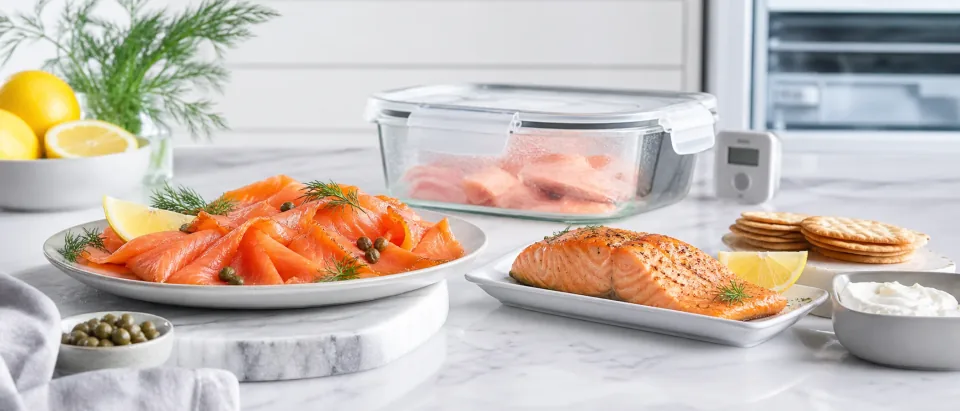
Smoked salmon during pregnancy: the safer split is lox or cold-smoked refrigerated seafood versus cooked salmon served hot. Clearer choices: cooked salmon, canned salmon, shelf-stable fish, or refrigerated smoked seafood heated until steaming hot. Check or avoid: cold lox, refrigerated seafood spreads, recalled products, and chilled ready-to-eat seafood eaten cold because Listeria risk changes the answer.
Source basis: This guide cross-checks the practical answer against CDC, FDA/EPA, FoodSafety.gov and the full references listed below.
CDC and FDA listeria source map
Searchers often name CDC, FDA, listeria, deli meat, smoked seafood, and steaming-hot rules in the same query. Use the source path below before treating every listeria search as the same food decision.
Cold-smoked and cooked salmon are not the same question
Smoked salmon while pregnant is a version question. Refrigerated cold-smoked salmon, lox, and smoked seafood spreads are ready-to-eat chilled foods; cooked salmon served hot is a different decision. CDC pregnancy food-safety guidance cautions on refrigerated smoked seafood unless it is cooked.
That does not mean salmon itself is off the table. FDA/EPA fish guidance supports low-mercury fish choices during pregnancy, and cooked salmon can fit that pattern. The practical move is to choose cooked, canned, shelf-stable, or steaming-hot seafood when the smoked version is refrigerated.
Clearer choice
Check or avoid
Practical step
After eating
Exact foods
Cooked, canned, or shelf-stable salmon
Cold-smoked salmon, lox, or seafood spread
Already ate it
Why refrigerated smoked seafood is the caution point
The split is Listeria and ready-to-eat storage, not salmon itself. Cooked low-mercury fish can be a useful pregnancy food, while refrigerated smoked seafood is the caution point because it is often eaten cold.
Two servings that look similar can carry different risk if one is cooked until steaming hot and the other is chilled, ready-to-eat, recalled, or stored too long. That is why “smoked salmon” needs the preparation detail.
Lower concern
Caution point
Best next move
How to order or prepare it safely
At a restaurant or deli, ask whether the smoked salmon is cold-smoked and served cold, or heated until steaming hot. At home, check whether the product is refrigerated or shelf-stable, whether it has been recalled, and whether you can heat it thoroughly.
If the server, label, or package cannot answer that split, choose cooked salmon instead of cold-smoked salmon. That keeps the benefit of fish without guessing about refrigerated ready-to-eat seafood.
If you already ate it
If you already had smoked salmon while pregnant, one serving does not automatically mean something bad happened. Write down the brand or restaurant, time eaten, amount, whether it was cold or heated, and any package details. If the food was packaged, check recall information.
Call your clinician or local advice line if fever, vomiting, diarrhea, dehydration, severe cramps, stiff neck, confusion, loss of balance, or flu-like illness appears, or if the exposure involved a recalled food. If you feel well, the most useful next step is usually to avoid the unclear version next time and choose the safer preparation.
Write down
Watch for
Ask for care advice
Safer swaps that keep the meal easy
The safer swap is the version with the chilled ready-to-eat risk removed. Choose cooked salmon, canned salmon, shelf-stable fish, or a hot salmon dish instead of cold lox or refrigerated seafood spread.
For bagels or brunch, that might mean cooked salmon, a vegetable topping, pasteurized cream cheese from a clean source, or another protein. The goal is not to make the meal joyless; it is to remove the refrigerated smoked seafood uncertainty.
At home
At restaurants
When unsure
How we checked this
We checked CDC safer-food guidance for pregnancy, FDA/EPA fish advice, FoodSafety.gov pregnancy guidance, and FDA food-safety guidance for people at higher risk. This guide separates refrigerated smoked seafood from cooked, canned, and shelf-stable fish; it is educational and does not diagnose or replace your care team.
References
Source-cited references used for this article. Open the original guidance when you want the public-health details behind the summary.