Not drinking is safest, say CDC, the NHS and Ireland’s HSE. If you do have a drink, they say to wait about 2 hours per drink before feeding, and pumping and dumping does not clear alcohol from your milk any faster.
At a glance
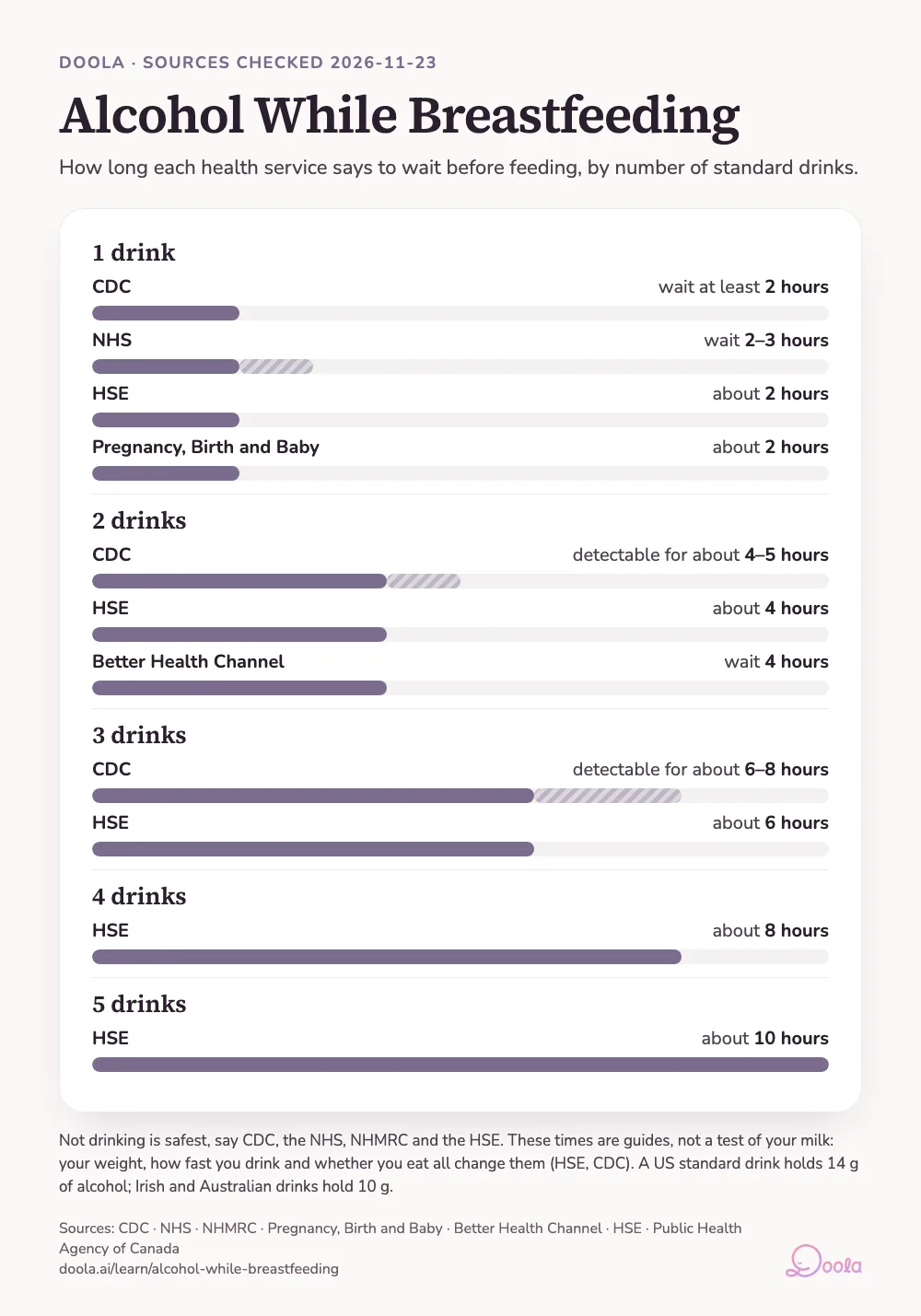
How long each health service says to wait before feeding
After one drink, every service here puts the wait at about 2 hours. Feeding just before you drink gives you the longest natural gap.
See every number as a table
| Standard drinks | CDC | NHS | HSE | Pregnancy, Birth and Baby | Better Health Channel |
|---|---|---|---|---|---|
| 1 drink | wait at least 2 hours | wait 2–3 hours | about 2 hours | about 2 hours | — |
| 2 | detectable for about 4–5 hours | — | about 4 hours | — | wait 4 hours |
| 3 | detectable for about 6–8 hours | — | about 6 hours | — | — |
| 4 | — | — | about 8 hours | — | — |
| 5 | — | — | about 10 hours | — | — |
Drinking while breastfeeding, at a glance
Alcohol moves from your blood into your milk, and it leaves your milk the same way it leaves your blood: with time. Pregnancy, Birth and Baby says this takes about 30 to 60 minutes after you drink, and CDC says milk levels are usually highest around then. That one fact explains most of the rules below: waiting works, and pumping does not speed it up.
Not drinking
Wait at least 2 hours
The wait adds up
Does not clear it faster
Keep baby off your bed
The first month is different
How long to wait to breastfeed after drinking
This chart shows only the numbers each health service publishes. They are guides, not a test of your milk: the HSE notes that your weight, how fast you drink, and whether you eat with it all change the timing, and CDC lists the same factors.
One thing to watch: a “standard drink” is not the same size everywhere. CDC’s US standard drink holds 14 g of pure alcohol. The HSE and Australia’s NHMRC use 10 g. So a US drink is a little bigger than an Irish or Australian one, and a large glass of wine or a strong craft beer can count as two or more.
| Standard drinks | What each source says | Keep in mind |
|---|---|---|
| 1 drink | CDC: wait at least 2 hours before nursing; alcohol can be detected in milk for about 2 to 3 hours. NHS: wait at least 2 hours, and for a social occasion it suggests 2 to 3 hours per drink. HSE: 2 hours. Pregnancy, Birth and Baby: about 2 hours for one standard drink to clear your body. | Feeding just before your drink gives you the longest natural gap before the next feed. |
| 2 drinks | CDC: detectable for about 4 to 5 hours. HSE: 4 hours. Better Health Channel: wait 4 hours. | CDC says more than one drink a day is not recommended while breastfeeding. |
| 3 drinks | CDC: detectable for about 6 to 8 hours. HSE: 6 hours. | Plan expressed milk for the feeds in this window. The HSE suggests expressing enough beforehand for whoever is minding your baby. |
| 4 drinks | HSE: 8 hours. | You may need to express for comfort while you wait; that milk will contain alcohol. |
| 5 drinks | HSE: 10 hours. | The NHS counts more than 6 units in one session as binge drinking and says a sober adult should care for your baby. |
Is one drink okay? Where the health services differ
Every source here agrees that not drinking is the safest choice. Where they differ is how they talk about an occasional drink. We show each one in its own words rather than blending them, so you can see the range and decide with your own care team.
| Source | On an occasional drink | Timing advice |
|---|---|---|
| CDC (US) | Not drinking is safest. Up to one standard drink in a day is not known to harm a baby; more than one a day is not recommended. | Wait at least 2 hours after a single drink before nursing. |
| NHS (UK) | Cites the Royal College of Midwives: the safest approach is to avoid alcohol completely. Also says an occasional drink is unlikely to harm your baby. | Wait at least 2 hours after a drink; for social occasions, 2 to 3 hours per drink. |
| NHMRC (Australia) | For women who are breastfeeding, not drinking alcohol is safest for their baby. | Better Health Channel (Victoria) says current evidence suggests no “safe” or “no-risk” level, and to wait up to 2 hours per standard drink if you choose to drink. |
| HSE (Ireland) | Avoid alcohol until your baby is 1 month old. | About 2 hours per standard drink, as a guide only. |
| Public Health Agency of Canada | Avoiding alcohol is the safest approach, especially when your baby is very young. An occasional drink can be okay if you plan for it. | Breastfeed or express first, then wait at least 2 hours per drink. |
Planning for a wedding, dinner, or night out
If you have an occasion coming up, a little planning lets you enjoy it without doing maths at midnight. The steps below come straight from the NHS, HSE, CDC, and Canada’s postpartum guide.
Safe sleep after drinking
If the wait runs long
Does your baby’s age change the answer?
Yes, for the youngest babies. The HSE says to avoid alcohol until your baby is 1 month old, because young babies have an immature liver and clear alcohol more slowly than an older baby or adult. Better Health Channel also advises avoiding it in the first month while breastfeeding is being established, and Canada’s guide says a very young baby cannot process alcohol well.
The NHS adds a practical point: skipping a feed and using expressed milk works better once breastfeeding is well established. If your baby was born early or is unwell, the HSE says to ask your baby’s doctor whether it is okay to drink at all.
Best avoided
The HSE and Better Health Channel both advise avoiding alcohol while feeding is being established and your baby feeds very often.
Plan any drink around feeds
Better Health Channel suggests limiting it to one or two standard drinks occasionally. Feed first, then allow the waiting time in the chart above.
Ask first
The HSE says to check with your baby’s doctor before drinking any alcohol.
Pump and dump, water, and milk supply: what is true
“Pumping and dumping clears it out.” It does not. CDC says pumping and discarding milk does not lower the alcohol in your milk any faster, and the NHS says you do not need to express to clear alcohol from your milk. Alcohol leaves your milk as it leaves your blood. Pumping is still useful if you feel full or want to keep your usual pumping times.
“Drinking water will flush it through.” The HSE says neither drinking water nor expressing will clear alcohol from your body any faster. Only time does that.
“A drink helps the milk flow.” None of these sources say so. CDC says that drinking more than a moderate amount can interfere with let-down. The NHS says drinking too much may reduce your supply, and the HSE says regular drinking can reduce it.
“If I had a drink, I should stop breastfeeding.” CDC says plainly that drinking is not a reason to stop breastfeeding. Planning the timing of your next feed is the step that matters.
What alcohol in breast milk can do to a baby
The HSE says research shows breastfeeding after 1 or 2 standard drinks can disrupt a baby’s sleep, and that it cannot say for sure whether very small amounts have any long-term effects. CDC says up to one standard drink a day is not known to be harmful, while heavier exposure could affect a baby’s development, growth, and sleep. The NHS says regularly drinking above recommended limits may cause sleep, growth, and development problems.
If you fed your baby sooner than planned after a drink, that is a common worry, not a reason to panic. Watch how your baby is feeding and sleeping, and call your baby’s doctor or nurse if anything seems off or you are worried.
When to talk to someone
Ask your baby’s doctor before drinking if your baby was born premature or is unwell, as the HSE advises. If you often drink more than you planned, or regularly binge drink, the NHS suggests talking with your health visitor or GP; in other countries, your doctor, midwife, or child health nurse can help. That is a normal conversation to have, and it will not change their care for your baby.
If you are worried about your baby at any point, call your baby’s doctor, or your local emergency number in an emergency. This guide is educational: it cannot judge your alcohol level, test your milk, or tell you when a specific feed is safe.
Ask before drinking
Get support
Questions parents ask about alcohol and breastfeeding
Short answers to the questions people ask most, each tied to the source that says it.
How long do you have to wait to breastfeed after drinking alcohol? expand_more
What happens if my baby drinks breast milk that has alcohol in it? expand_more
What happens if you have one alcoholic drink while breastfeeding? expand_more
Do I need to pump and dump after drinking? expand_more
Can I drink alcohol in the first month of breastfeeding? expand_more
How much is one standard drink? expand_more
Can I sleep with my baby after a drink? expand_more
How we checked this
The Doola Research Team read the current alcohol and breastfeeding guidance from CDC, the NHS, Australia’s NHMRC, Pregnancy, Birth and Baby, Better Health Channel, Ireland’s HSE, and the Public Health Agency of Canada, and checked each statement against the source page on Nov 23, 2026. Where the services describe an occasional drink differently, we show each one side by side instead of choosing between them. This guide is educational: it does not diagnose, test breast milk, or replace advice from your baby’s doctor, midwife, or lactation support.
References
Source-cited references used for this article. Open the original guidance when you want the public-health details behind the summary.
 Breastfeeding and drinking alcohol
nhs.uk
open_in_new
The Doola app
The next question, answered with sources.
Scan menus, labels and plates, ask follow-up questions in your own words, and keep what you learn for your next appointment.