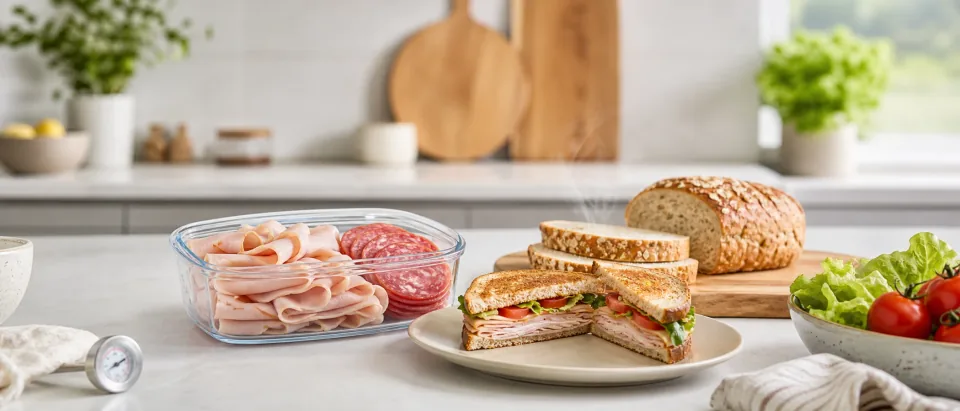
Deli Meat and Cold Sandwiches During Pregnancy: deli meat heated until steaming hot and eaten promptly, or a vegetarian sandwich made with freshly handled ingredients is usually the clearer pregnancy choice. Check this first: ask for the meat to be heated until steaming hot, eat it promptly, and avoid cold leftovers. Avoid or call: cold deli meat, old prepared sandwiches, recalled products, or meat from a counter with unclear handling; call your clinician for fever, chills, flu-like aches, vomiting, diarrhea, dehydration, or feeling seriously unwell after deli meat.
Source basis: This guide cross-checks the practical answer against CDC, FoodSafety.gov, FDA and the full references listed below.
CDC and FDA listeria source map
Searchers often name CDC, FDA, listeria, deli meat, smoked seafood, and steaming-hot rules in the same query. Use the source path below before treating every listeria search as the same food decision.
The useful split for deli meat and cold sandwiches
The safest answer is not just yes or no. For deli meat and cold sandwiches, the pregnancy decision changes with preparation, storage, and whether the risky version is cooked, pasteurized, washed, or served cold. CDC and FoodSafety.gov advise heating deli meat and hot dogs until steaming hot for pregnancy. That is why the most useful move is to check the version in front of you rather than relying on a generic food list.
Clearer choice
Check or avoid
Practical step
After eating
Exact foods
Clearer choice
Check or avoid
Already ate it
Why the answer changes by version
Pregnancy food-safety guidance consistently treats refrigerated ready-to-eat meats as a listeria concern unless heated thoroughly. This is the detail many short pregnancy food lists miss. Two servings that look similar can carry different risk if one is cooked, pasteurized, washed, or chilled correctly and the other is raw, unverified, recalled, or held too long.
For deli meat and cold sandwiches during pregnancy, the decision becomes clearer when you identify the risk-changing detail before eating. The article separates the lower-concern version from the caution version, then gives an after-eating action so a worried reader does not have to search again while trying to remember the meal.
Lower concern
Caution point
Best next move
How to order or prepare it
For deli meat and cold sandwiches during pregnancy, ask the preparation question that matches the food in front of you, then choose the version that is easiest to verify. The relevant source set is CDC, FoodSafety.gov, FDA; those sources separate safer choices from raw, undercooked, unpasteurized, poorly chilled, recalled, or otherwise uncertain foods. In practice, check the safety detail before ordering rather than trying to judge risk from the food name alone.
The lower-concern version is deli meat heated until steaming hot and eaten promptly, or a vegetarian sandwich made with freshly handled ingredients. The caution version is cold deli meat, old prepared sandwiches, recalled products, or meat from a counter with unclear handling. If the server, label, or package cannot answer that split, ask for the meat to be heated until steaming hot, eat it promptly, and avoid cold leftovers. That gives the page a clear action path: verify, choose the safer version, or skip the uncertain one.
If you already ate it
If you already had deli meat and cold sandwiches during pregnancy, one serving does not automatically mean something bad happened. Write down the brand or restaurant, time eaten, amount, temperature, storage clue, and the exact detail that made the food uncertain. If the food was packaged, check recall information and keep the package details until you feel confident no follow-up is needed.
Call your clinician or local advice line if fever, chills, flu-like aches, vomiting, diarrhea, dehydration, or feeling seriously unwell after deli meat appears, or if the exposure involved a recalled food. If you feel well, the most useful next step is usually to avoid the unclear version next time and choose the safer preparation.
Write down
Watch for
Ask for care advice
Safer swaps that keep the meal easy
For deli meat and cold sandwiches during pregnancy, the safer swap is not just a bland alternative; it is the version with the risky detail removed. Use deli meat heated until steaming hot and eaten promptly, or a vegetarian sandwich made with freshly handled ingredients when you can verify it. If the only available option is cold deli meat, old prepared sandwiches, recalled products, or meat from a counter with unclear handling, choose a different preparation or wait for a clearer source.
This matters for searchers because official guidance from Centers for Disease Control and Prevention is often broad, while the meal decision is specific. The swap should preserve the meal idea while changing the food-safety variable: heat it, choose pasteurized, wash it, keep it cold, check the package, or avoid the recalled or uncertain item.
At home
At restaurants
When unsure
How we researched this
For deli meat and cold sandwiches during pregnancy, Doola reviewed CDC, FoodSafety.gov, FDA and translated the guidance into a parent-facing safety decision: what is usually lower concern, what should be checked or avoided, and when symptoms or recalls should move the question to a clinician. This source mix gives the page concrete public-health grounding while keeping diagnosis and treatment decisions outside the article.
References
Source-cited references used for this article. Open the original guidance when you want the public-health details behind the summary.