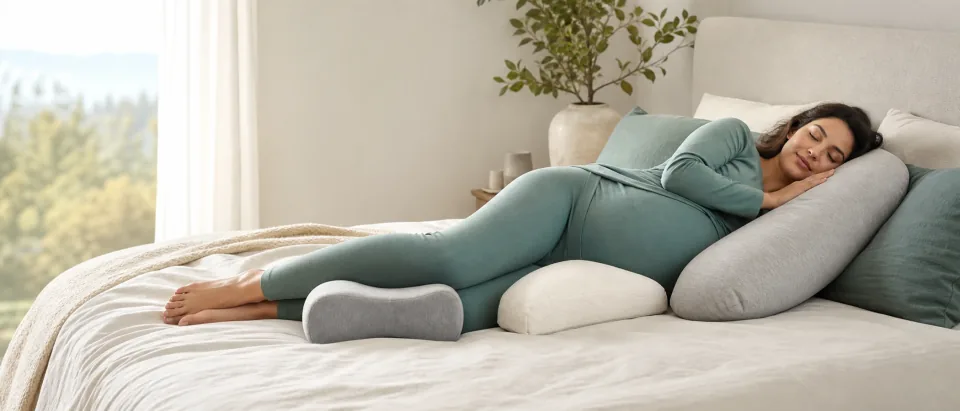
Pregnancy pillow types are less about one perfect shape and more about the problem you are trying to solve. A full body or U-shaped pillow helps if you roll, a wedge helps if your bump pulls, and a knee pillow helps if your top leg drags your hip or pelvis. If pain limits walking, stairs, turning in bed, or getting out of a car, treat it as a care question, not only a shopping question.
Source basis: This guide cross-checks the practical answer against NHS, RCOG and the full references listed below.
Start with the sleep problem, not the pillow shape
A pregnancy pillow is usually a support tool, not a cure. NHS back-pain guidance supports a common first step: knees bent with a pillow between them to reduce strain. Check which pressure point wakes you up before buying the biggest pillow on the page.
Your top leg pulls your hip forward
Your belly feels like it drops sideways
You keep waking on your back
Turning in bed or stairs hurt too
Claims sound too strong
Pregnancy pillow types, compared by what they actually support
The most useful way to compare pregnancy pillow types is by the support job, not by size. NHS back-pain guidance gives the basic mechanism: side sleeping with bent knees and a pillow between them can reduce strain. A knee pillow targets that alignment directly; a wedge adds bump lift; a long body pillow combines knee and torso support; C-shaped and U-shaped pillows add back bracing when rolling becomes the bigger problem.
Product claims can make every pillow sound essential, but a smaller setup is often the best first test. If one normal pillow between the knees reduces hip pressure, the right product type is probably knee or body support. If bump pull is the issue, a wedge may be enough. If several pillows keep shifting, a larger C-shaped or U-shaped pillow may be worth checking.
Knee pillow
Wedge pillow
Long body pillow
C-shaped pillow
U-shaped pillow
When pillow support usually starts to matter
The pillow question often changes as the bump grows and side sleeping becomes more awkward. Early on, a normal pillow may be enough. Later, hip pressure, bump pull, heat, and back rolling can make a more specific shape useful.
Early pregnancy
Try knee support first if sleep is still mostly comfortable.
Mid pregnancy
A wedge or folded towel can check whether small bump lift helps.
Later pregnancy
A body, C-shaped, or U-shaped pillow may help if separate pillows keep shifting.
Choose by what wakes you up
Use a three-night support check before buying. Night one: place a firm pillow between the knees, which matches the NHS posture idea for reducing back and hip strain. Night two: add a folded towel or wedge under the bump if the belly pulls sideways. Night three: add back support only if you keep rolling or waking on your back.
The result tells you what to buy. If knee support is the clear win, choose a knee pillow or long body pillow. If bump lift is the win, choose a wedge. If you need knee, bump, and back support at once, a C-shaped or U-shaped pillow may make sense. If pain continues during walking, stairs, dressing, or turning in bed, NHS and RCOG pelvic-pain guidance are the better next step.
Hip pressure
Bump drag
Back rolling
Too much heat
When a pillow is not the whole answer
A pillow can reduce sleep pressure, but it is not the whole answer when pain changes daily movement. Ask a midwife, GP, or physiotherapist if hip or pelvic pain makes walking, stairs, standing on one leg, turning in bed, dressing, or getting out of a car difficult. NHS pelvic-pain guidance lists those movement problems, and RCOG says early diagnosis and treatment can relieve pain and help daily activity.
This distinction protects the buying decision. If support makes sleep easier and daytime movement is normal, a pillow choice may be enough. If movement is limited, the next step is care advice; a pillow may still help comfort, but it should not be the only plan.
How Doola fits when product claims get noisy
Pregnancy pillow pages often mix ordinary comfort claims with stronger-sounding support language. The details worth checking are concrete: product type, fill, cover fabric, washable parts, heat, return policy, size, and whether the listing claims to treat pain. Doola can help compare exact product wording without turning a pillow listing into medical advice.
Use the product checker when a page says “pregnancy safe,” “pelvic support,” or “pain relief” but does not clearly explain what the pillow actually does. The safer shopping question is not “which pillow is best for everyone?” It is “does this product type match my support problem, and are the materials and claims clear?”
How we checked this guide
The Doola Research Team used NHS pregnancy back-pain and sleep guidance plus NHS/RCOG pelvic-pain guidance to keep this page practical and non-diagnostic. We treated pillows as positioning support, not treatment. Product advice focuses on matching shape to sleep problem, while movement-limiting hip or pelvic pain is routed toward care advice.
We also checked common SERP-style pregnancy pillow comparisons so this guide answers real shopping questions: wedge versus body pillow, U-shaped versus smaller support, normal pillow first, and what product type to choose for hip pressure or bump pull.
Related questions parents ask
These answers combine purchase-intent questions with NHS and RCOG guidance about when pain should be discussed with a care team. The buying decision is simple when discomfort is only nighttime pressure that improves with support. The answer changes when hip or pelvic pain limits walking, stairs, dressing, turning in bed, or getting out of a car.
Which pregnancy pillow product type is best for hip pain? expand_more
Is a wedge pillow enough during pregnancy? expand_more
Do I need a U-shaped pregnancy pillow? expand_more
Can a normal pillow work instead of a pregnancy pillow? expand_more
When should I stop shopping and ask about pelvic pain? expand_more
References
Source-cited references used for this article. Open the original guidance when you want the public-health details behind the summary.